
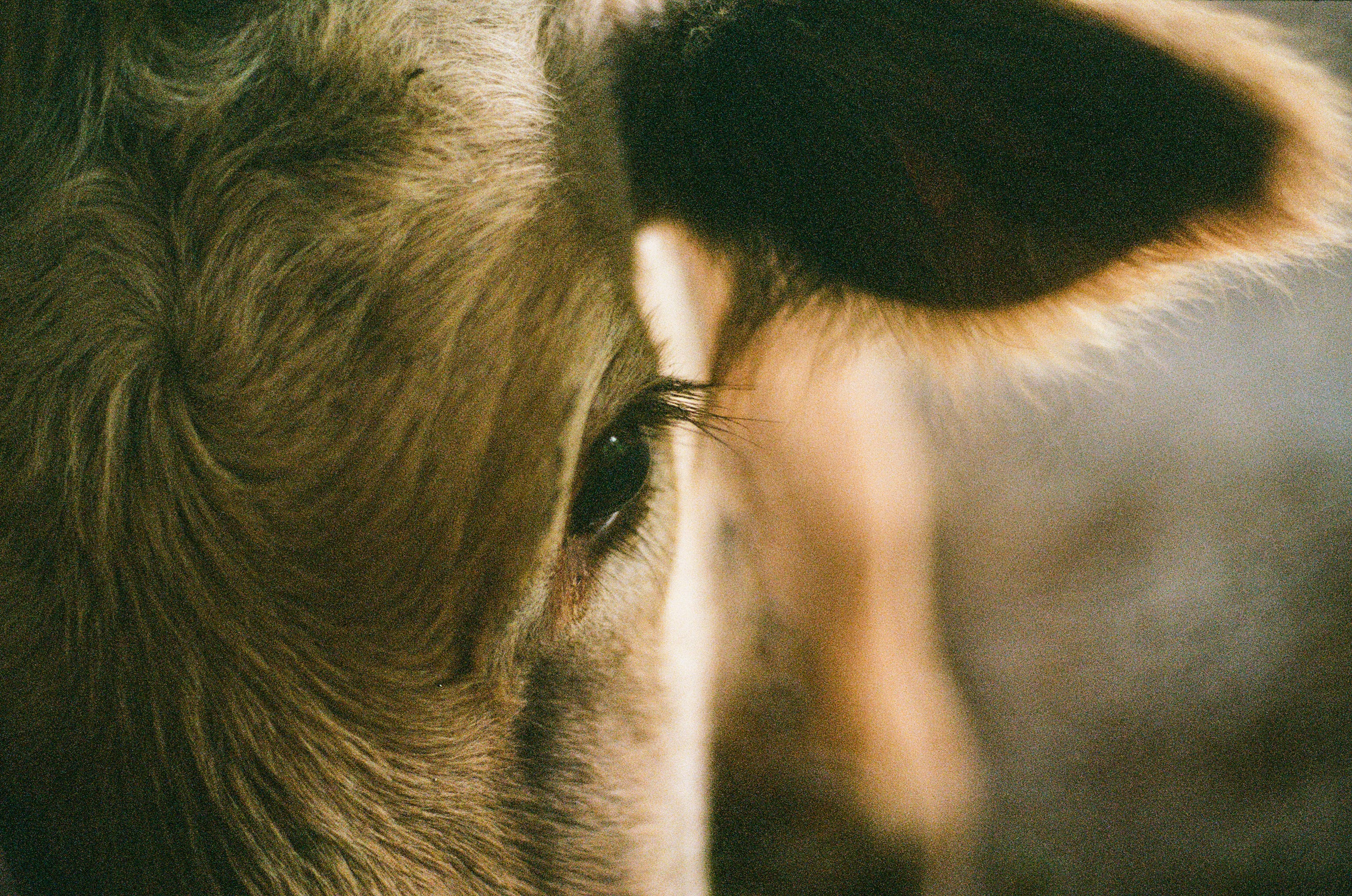
The cow arrives at Serifzada Street in a small trailer with its head lashed to the front, standing. The sun is still below the horizon. This is the only shop that’s lit. A sign above the door shows a grassy hillside with a cow, a sheep, and a chicken Photoshopped on top, each looking fat, healthy, and content.
The cow is led out of the trailer and onto the sidewalk in front of the shop. The butcher binds her hooves and slowly works her down onto one side. He draws a knife across her throat and a tremendous amount of blood spills onto the concrete. Once the blood is no longer rushing she’s strung up on a metal beam. She’s skinned, gutted, and cut into steaks and roasts and ribs. By the end of the day her meat will be completely sold off — but not to me.
It might seem odd for someone opposed to eating animals to include, in a collection of essays celebrating different aspects of Azerbaijan, a description of a cow being killed on a sidewalk. And yet part of me finds something worthy. Not of celebration, but of recognition.
In America we prefer to believe that the animal we eat spends its entire life grazing lush grass in a bright green field and then, in an instant, magically transforms into the burger on our plate. From the time we are children this is the story we’re told, by books and movies, packaging and advertisements. The reality is uglier, and hidden. In Azerbaijan, less so.
I don’t know for sure where this cow arrived from, but I’m confident it wasn’t a feedlot. Spend any time outside of Baku and you are sure to see small herds of cattle and sheep at the side of the road grazing on whatever manages to grow there. They wander through open fields and villages, usually accompanied by a cowherd, either an old man staring into the distance or a young man staring into his phone. Sometimes you see them in the city itself.
When a cow is slaughtered and hung up for sale the process is visible to everyone. You might see a cow killed on your way to work and then stop off on the way home to buy its meat. If the butcher does his job poorly, if he takes his anger out on the animals or is careless with his knife, I expect that someone would say something, or decide to spend their money elsewhere. I have nothing to back this up besides a belief in human decency. Most of us don’t like to see animals suffer.
Which is why so much of modern animal husbandry is hidden from us. I used to hide it myself. One of my first jobs was on a farm that raised chickens for slaughter. When I met our customers at the farmers’ market I didn’t tell them what it smelled like in the slaughterhouse, or how violently the birds flapped after their throats were cut.
In Azerbaijan, some of what we’ve come to hide in America still happens in the open, at little butcher shops like the one on Serifzada Street. Which means that a child, or an adult, is more likely to know the true cost of their meal.
You’ve just read an excerpt from “Look Again: Unconventional Love Letters to Azerbaijan.” If you enjoyed it, please consider buying the book. You can find it at the links below. If you’re in Azerbaijan, please contact Libraff.
Print: Amazon
eBook: Kobo, Apple Books, Amazon, etc.
If you’ve read it, please consider leaving a review online and sharing it with someone who might enjoy it.