
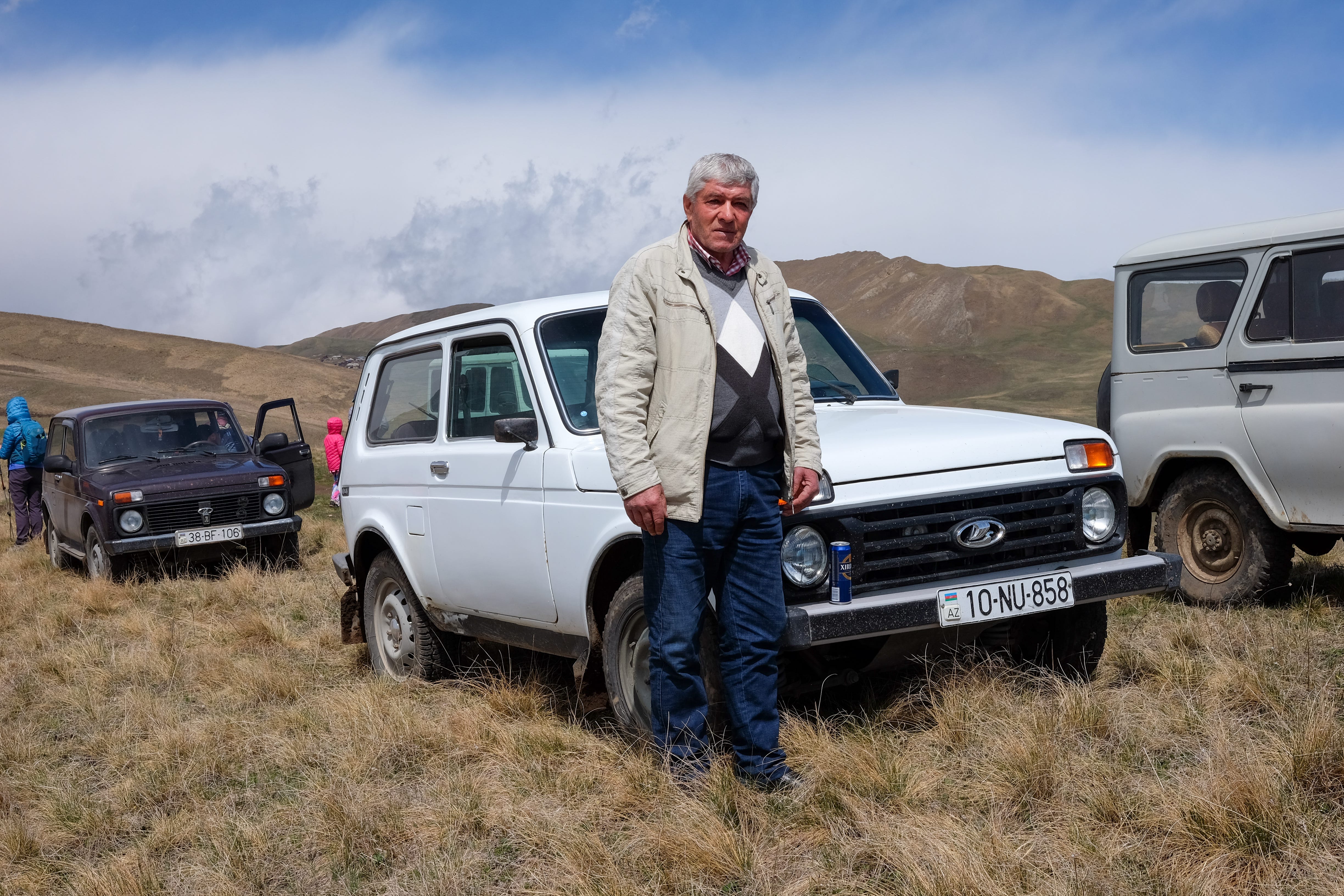
Imagine a lifted hatchback with four-wheel drive, 75 horsepower, and a locking center differential. Or imagine a mountain goat with wheels. The official name is the Niva, a Russian car made by Lada. It’s such a common sight in the hills and mountains of Azerbaijan that it’s difficult to imagine the country without them.
When I see them parked outside our apartment in Baku they’re often adorned with custom gear shift knobs, leather seats, and futuristic stereos. Outside of the city, which Azerbaijanis call “the regions,” they’re workhorses, connecting remote villages, some well above 6,000 feet in elevation, to the rest of the country.
I’ve ridden in them a dozen times and only once found a seatbelt. We were driving out of Quba, a city in the hills at the foot of the Caucasus, and headed toward Xinaliq, one of the highest mountain villages in the country. As I reached for it the driver shook his head and waved his hand, effectively saying that no seatbelt was necessary.
“Good driver!” he said, referring to himself. I didn’t want to offend him, but neither did I want to hurtle through his windshield at 80 kilometers per hour.
“Are the other drivers good?” I asked as I pulled the seatbelt across my chest. He tipped his head to the side and shrugged his shoulders.
Surely the Nivas are manufactured with seatbelts, but then someone must decide that this little matchbox of a car, which traverses some of the most harrowing roads I’ve ever been on, needs fewer safety features, or rather no safety features at all, and so they take them out.
Maybe they do it because of what it says about their driving, or maybe because a seatbelt would only slow you down if the car was about to roll off a cliff and you needed to get out quickly. The reality, I think, is that in many of the places I’ve ridden in Nivas, a seatbelt wouldn’t make a difference anyway.
I remember one journey in particular. I had family visiting from America. We’d just spent the night in another tiny village called Griz which is built right out to the edge of a cliff on the northern edge of the Caucasus Mountains. After wandering around the village in the morning it was time to return to the regional capital of Quba, and then onto Baku. The mode of transport was, naturally, the Lada Niva.
My mom sat in the back and I sat in the front. Our guide, Elvin, told us that if the road wasn’t too muddy we’d be able to take a shortcut. It wasn’t muddy. It wasn’t much of a road, either. It was more like driving along a hiking trail. We wove between boulders, creeped around switchbacks, and skirted sheer drops as we descended into the canyon. I wondered when the brakes had last been serviced. My poor mom, who hadn’t signed up for any of this, kept telling herself not to look out the window.
When we reached the bottom of the canyon I turned to see what we’d just driven down but I couldn’t find the road amid the cliffs and slopes and boulders. It was as if the Lada itself had conjured it, but only temporarily.
Another time my wife and I were being driven out of a nearby village called Qalahudat. We were coming up a hill when the driver recognized a friend tending a flock of sheep on the side of the road. He pulled the emergency brake and stepped out. When he was about 20 feet away we felt the car roll backwards. Not a foot, maybe not even an inch, but enough that every muscle in my body clenched, preparing to roll backwards off the mountain and into the deep canyon below. The driver heard it too, paused, and turned back to look. When we didn’t roll any further he turned back around. While he shared a cigarette with his friend I wondered how quickly we’d be able to climb out. There were no seatbelts to slow us down.
Sometimes I wonder how difficult it would be to pack a Niva out of Azerbaijan as a souvenir, like taking a carpet or a pair of slippers. Perhaps it could fit in oversize luggage. Of course it’s just a dream — I can only imagine how much red tape I’d have to navigate to export a car. And anyway, I’d be leaving behind the drivers, which make the Lada Niva what it is.
I don’t think I really understood this until I rode with well-dressed older man named Sahir from Laza up to a ridge line just below Mount Shahdag. After he dropped us off I asked for a photograph. He set down the can of Xirdalan he’d just opened and posed with his Lada Niva as if he were posing with his wife or child.
I’m not sure how Sahir feels about driving — he didn’t speak English and my Azerbaijani wasn’t good enough to exchange anything beyond pleasantries — but everything about how he carried himself, like his dapper clothes and the cleanliness of the car, said that he took pride in what he did. As he should.
You’ve just read an excerpt from “Look Again: Unconventional Love Letters to Azerbaijan.” If you enjoyed it, please consider buying the book. You can find it at the links below. If you’re in Azerbaijan, please contact Libraff.
Print: Amazon
eBook: Kobo, Apple Books, Amazon, etc.
If you’ve read it, please consider leaving a review online and sharing it with someone who might enjoy it.